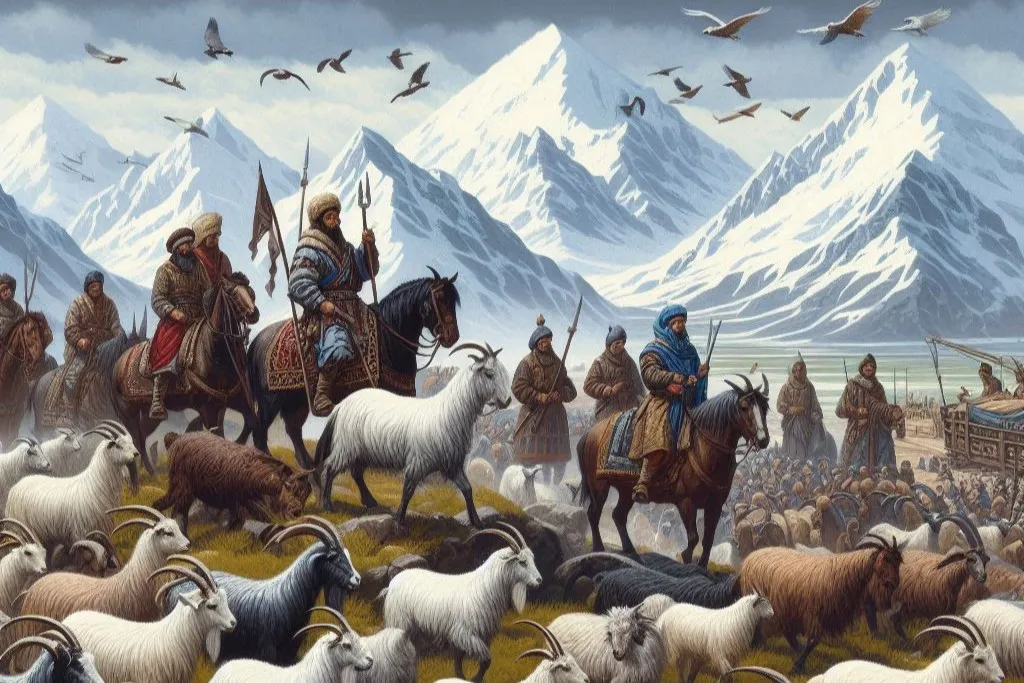
The Oğuz Kağan epic is one of the founding stories of the Turkic world. Its best-known version survives in a single manuscript written in the Uyghur script, now kept at the National Library of France in Paris. What follows is my own retelling of that story in plain English, for friends who don't read Turkish.
A child unlike any other
One day Ay Kağan gave birth to a son. His face was blue, his mouth fiery red, his eyes reddish and his hair and eyebrows black; he was more beautiful than the fairest spirits. The boy drank his mother's first milk only once and would drink no more. He asked instead for raw meat, food and wine, and he began to speak.
Forty days later he had grown, and he walked and played. His legs were like an ox's, his waist like a wolf's, his shoulders like a sable's and his chest like a bear's, and his body was covered in hair. He herded horses, rode, and went hunting. Days and nights passed, and he became a young man.
The beast in the forest
In those days there was a great forest with many rivers and streams, full of game and birds. In it lived a huge beast, the epic calls it a kıyant, often translated as a unicorn or rhinoceros, which ate horses and people. The people lived in fear of it.
Oğuz decided to hunt it. He took a spear, a bow and arrows, a sword and a shield, and set out. First he caught a deer, tied it to a tree with a willow branch and went away. The next morning the deer was gone; the beast had taken it. Then he caught a bear and tied it to the tree with his golden belt. The next morning the bear was gone too. So Oğuz waited under the tree himself. When the beast came, it struck his shield with its head, and Oğuz drove his spear into its head and killed it. He cut off its head with his sword and went on his way.
Two wives, six sons
One day, while Oğuz was praying to the sky, darkness fell and a blue light came down from the heavens, brighter than the sun and the moon. Inside the light sat a girl, so beautiful that when she laughed the blue sky laughed, and when she cried the blue sky cried. Oğuz fell in love with her and married her. They had three sons, named Gün (Sun), Ay (Moon) and Yıldız (Star).
Another day, out hunting, Oğuz saw a tree in the middle of a lake, and in a hollow of the tree sat another girl, her eyes bluer than the sky and her hair flowing like the waves. He married her as well, and they had three more sons: Gök (Sky), Dağ (Mountain) and Deniz (Sea).
The grey wolf
Oğuz held a great feast for his people and declared himself their khagan. A well-known modern Turkish rendering of his proclamation goes: "I have become your khagan; let us take up bow and shield. Let our sign be good fortune, and let the grey wolf be our battle cry."
He sent word to the four corners of the world that all should submit to him. Some came of their own accord; others, like Urum Kağan, refused, and Oğuz marched against them. One morning, as his camp woke, a beam of light like sunlight fell into his tent, and out of it stepped a great male wolf with a grey coat and a grey mane. "Oğuz," the wolf said, "you want to march against Urum. I will walk at the head of your army." From then on the grey wolf led the way, and wherever it stopped, the army stopped, and Oğuz won battle after battle.
The golden bow and the silver arrows
Years later, Oğuz's wise old minister, Uluğ Türük, had a dream. He saw a golden bow stretching from where the sun rises to where it sets, and three silver arrows flying north. He told Oğuz, and Oğuz sent his sons out to hunt: the three eldest toward the east, the three youngest toward the west. The elder sons found a golden bow; the younger found three silver arrows.
Oğuz broke the golden bow into three pieces and gave one to each of his elder sons, telling them that, like the bow, they should shoot their arrows far into the sky. To the younger sons he gave the three silver arrows, telling them to be the arrows sent out by the bow. The descendants of the elder sons became known as the Bozok, those of the younger sons as the Üçok, the two wings of the Oghuz people. Later tradition traces the twenty-four Oghuz tribes to the four sons each of these six brothers had.
Then Oğuz held one last great feast, divided his lands among his sons and passed his realm on to them.
Why the story still matters
Oğuz Kağan is remembered as the legendary ancestor of the Oghuz Turks, whose descendants include today's Turks of Türkiye, Azerbaijanis and Turkmens. Some historians have linked him to Mete Han (Modu Chanyu), who ruled the Xiongnu from 209 to 174 BC, though that connection is a matter of interpretation rather than fact. Either way, many symbols that still matter to Turks come from this story: the grey wolf as guide, the sky as sacred, and the bow and arrows that once marked the order of a whole people.